Vietnamese students join international "white-hat hacker" camp in Russia

VOV.VN - Overcoming more than 800 applicants worldwide, three Vietnamese students participated in the international Positive Hack Camp running from July 27 to August 9 in Moscow, Russia.
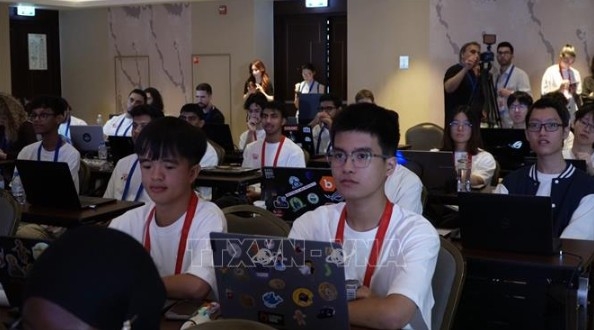
The two-week program attracted 70 students from 20 countries, offering a professional environment for aspiring cybersecurity experts.
The camp, organized by Positive Technologies and Positive Education with support from the Russian Ministry of Digital Development, has become a notable event in the global information security community since 2024.
The three Vietnamese representatives, hailing from Hanoi University of Science and Technology, Vietnam-Hungary Industrial University, and Swinburne Vietnam, secured their spots after a rigorous selection process.
Participants noted that meeting technical prerequisites was matched by a strict requirement for professional English proficiency to collaborate effectively with peers from Egypt, India, Indonesia, China, Malaysia, and nations across Southeast Asia, the Middle East, Africa, and Latin America.
For Lo Hai Long, a final-year student at Hanoi University of Science and Technology, funding his own travel to Moscow proved entirely worthwhile. Currently working in information security, Long stated that the program gathers highly capable individuals pursuing diverse specializations.
He outlined two main objectives for joining the camp: enhancing incident response skills and overall cybersecurity knowledge, and connecting with a high-caliber international peer network.
At the opening ceremony, Russian Deputy Minister of Digital Development Alexander Shoitov emphasized that international cooperation in the project builds essential capacities to enhance national digital security while fostering long-term global collaboration in IT and cybersecurity. He noted that identifying and neutralizing digital threats remains a critical condition for safeguarding national information security.
The curriculum features intensive, practical training led by experts from Positive Technologies, alongside international advisors such as Hussein Daher and Mohammed Daher from Lebanon, researchers who have uncovered over 2,000 published software vulnerabilities.
Over the two weeks, participants engage in 30 practical sessions involving simulated IT system attacks, infrastructure analysis, network traffic evaluation, and privilege escalation techniques across web applications, operating systems, and computer networks.
Beyond technical training, Positive Hack Camp serves as a career catalyst, giving cultural programs and city tours in Moscow while covering all program expenses for accepted candidates.

Vietnamese primary school students lead SEA in Mathematics and Reading
VOV.VN - Vietnam ranked first in Mathematics and Reading and second in Writing in the 2024 cycle of the Southeast Asia Primary Learning Metrics (SEA-PLM), according to the country's national report released on July 14.

All 34 Vietnamese students win prizes at World Mathematics Invitational
VOV.VN - All 34 Vietnamese students competing at the World Mathematics Invitational (WMI) 2026 in Tokyo, Japan, from July 10 to 14 have won prizes, including two Diamond Awards and five Gold Awards.