Vietnam prepares first dedicated law on commodity derivatives trading

VOV.VN - The Government has approved the policy for developing the country's first dedicated Law on Commodity Derivatives Trading, which is expected to establish a unified legal framework, give businesses greater tools to hedge against price volatility and bring the market closer to international standards.
The law would be the first specialised legislation in Vietnam to comprehensively regulate commodity derivatives trading, covering traded products, market participants, trading methods, market infrastructure, clearing and settlement, risk management and transactions involving foreign elements.
Commodity derivatives trading is already conducted in Vietnam, but the activity is currently governed mainly by provisions scattered across different legal documents. The proposed dedicated law is therefore expected to establish a more unified, consistent and transparent legal framework for the market.
Giving businesses more tools to hedge price risks
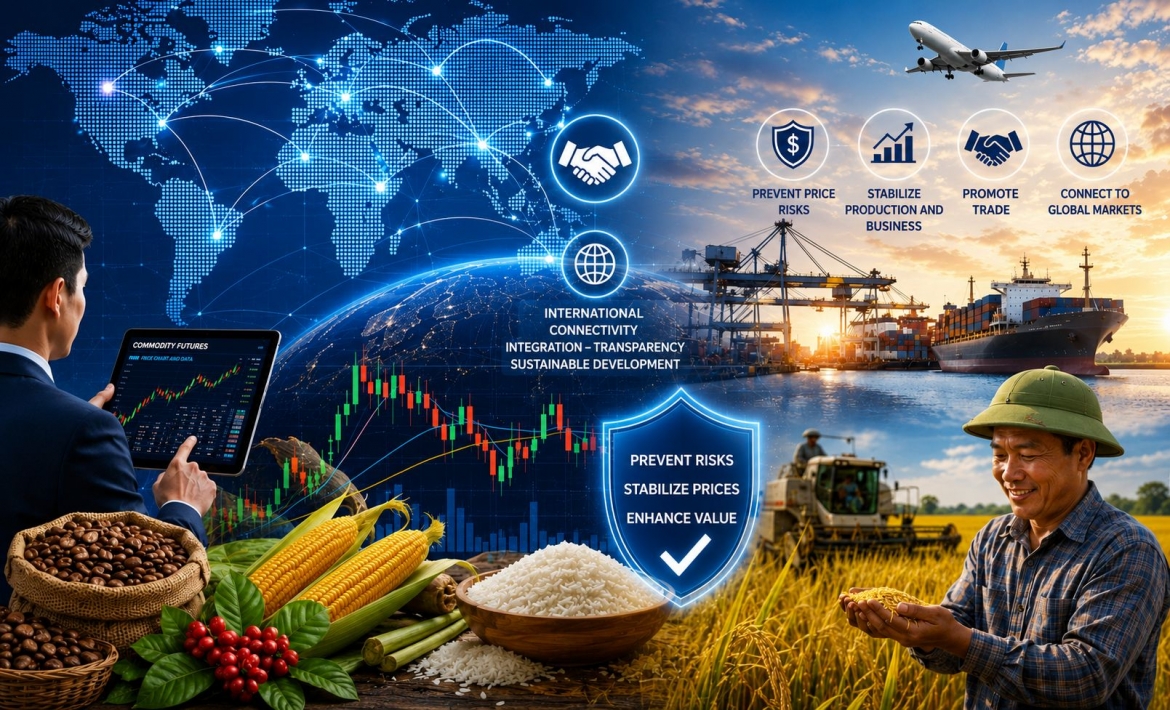
One of the key objectives of the draft law is to develop the commodity derivatives market in line with the practical needs of businesses.
Unlike conventional physical commodity trading, commodity derivatives allow businesses, producers and traders to enter into contracts based on the prices of underlying commodities, such as coffee, rubber, agricultural products and energy, enabling them to lock in purchase or selling prices for future transactions.
This can help businesses reduce their exposure to sharp fluctuations in commodity prices.
Under the Government's approach, the commodity derivatives market would develop in close connection with the underlying physical commodity market rather than separately from it. While the physical market provides the foundation of supply and demand, the derivatives market provides risk-management tools and can contribute to a more transparent price-discovery mechanism.
The draft law also aims to diversify products and trading methods and broaden participation by businesses, gradually making derivatives a practical tool supporting production and business activities.
Building a modern market with global links
Alongside the legal framework, the Government underlines the need to develop the market's infrastructure in a coordinated manner.
Institutions and mechanisms for clearing and settlement, margin requirements, collateral management and risk control would be developed in line with international practices to ensure the safety of the trading system.
Supporting infrastructure, including warehousing systems, warehouse receipts, commodity management systems and digital platforms, would also be developed to strengthen links between derivatives trading and the underlying physical commodities.
Another notable direction is to strengthen international market connectivity by developing rules governing cross-border transactions, while studying mechanisms for cross-listing and linkages with international markets.
According to the Government, this would create conditions for Vietnam's key export commodities, including coffee, rubber and agricultural products, to participate more deeply in global trading networks. It would also give domestic businesses greater access to international risk-management tools and price-discovery mechanisms.
Encouraging innovation, strengthening risk controls
The draft law also reflects a shift in the regulatory approach to the commodity derivatives market.
Rather than focusing solely on controlling trading activities, the Government aims to create a development-oriented regulatory environment, strengthen decentralisation and delegation of authority, and reinforce market supervision and risk management.
Notably, the draft law is considering a regulatory sandbox for new products, technologies and trading models. This would create room for innovation while maintaining safeguards for market stability and security.
At the same time, requirements concerning financial capacity, corporate governance, risk management and operating conditions for market participants would be strengthened. The authorities are also studying a framework for professional certification and standardising the qualifications required for certain operational positions.
Building on the policy groups approved by the Government, the Ministry of Industry and Trade will continue to lead the drafting and finalisation of the bill in accordance with the Law on Promulgation of Legal Documents.
Once enacted, the Law on Commodity Derivatives Trading is expected to provide a unified legal foundation for a modern, transparent and secure market, helping businesses proactively manage price risks, improve the competitiveness of Vietnamese commodities and strengthen the market's integration with regional and international markets.

Polish food firms reaffirm Vietnam as key Southeast Asian market
VOV.VN - Polish food producers continue to regard Vietnam as one of their priority markets in Southeast Asia, by stepping up trade promotion and business networking efforts to expand exports and capitalise on opportunities offered by the EU-Vietnam Free Trade Agreement (EVFTA).