Vietnam proposes space cooperation network for development and resilience

VOV.VN - Top Vietnamese leader To Lam has proposed that Vietnam, France, the United Nations, ASEAN and partners explore the creation of a space for development and resilience network, initially focused on Southeast Asia, alongside five principles for multilateral space governance.
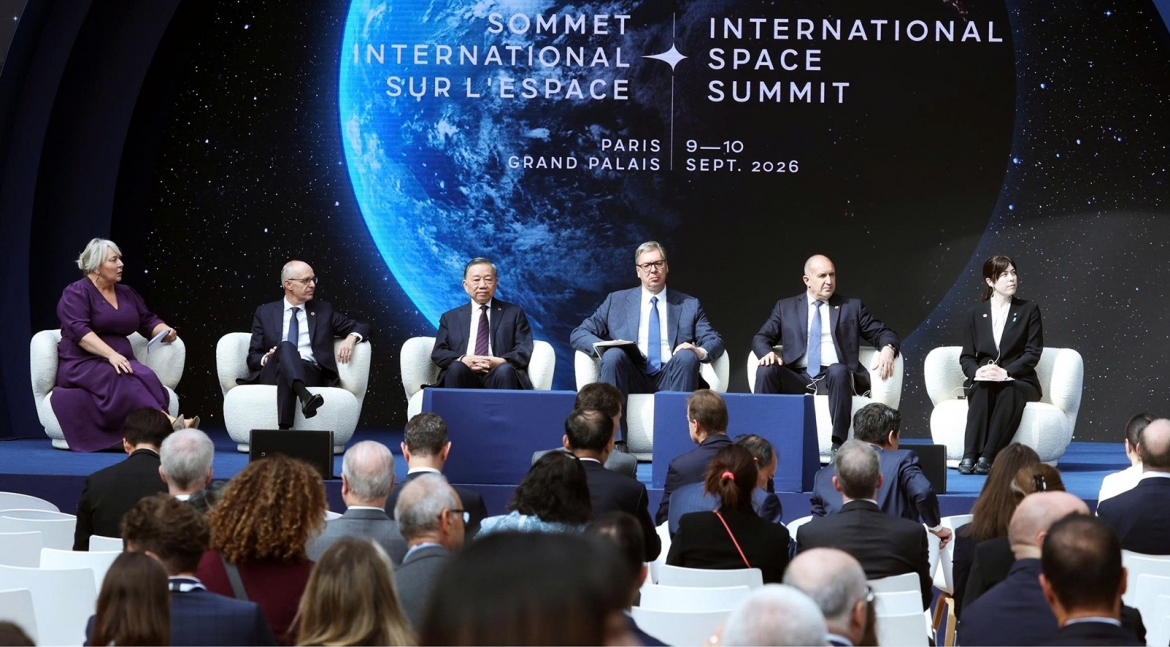
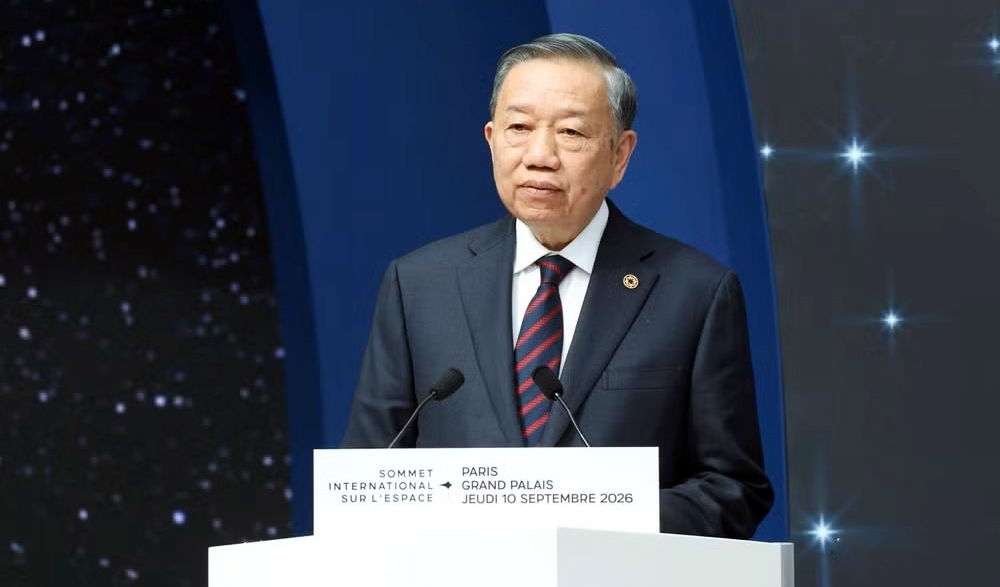
General Secretary of the Communist Party of Vietnam Central Committee and State President To Lam made the proposal at the 2026 International Space Summit in Paris on September 10.
The International Space Summit was held in Paris on September 9-10 at the initiative of French President Emmanuel Macron, bringing together leaders, representatives of international organisations, scientists, businesses and other space-sector stakeholders to discuss the future of the industry, international cooperation, technological innovation and the sustainable use of space.
Vietnam proposes space cooperation network
Speaking at the summit, General Secretary and State President To Lam welcomed the initiative to convene the event, saying it provided an opportunity for countries to shape a new vision for outer space based on the principle that capability development must go hand in hand with responsibility, and national interests must be aligned with the common interests of the international community.
According to the Vietnamese leader, outer space is increasingly becoming an essential part of modern life and the global economy. Technologies such as satellites, remote sensing, positioning and space-based data are directly supporting telecommunications, transport, resource management, disaster prevention and climate change response.
At the same time, the rapid expansion of space activities is creating new challenges, including space debris, collision risks, orbital and spectrum management, militarisation, technological gaps and the growing role of the private sector.
In this context, General Secretary and State President To Lam proposed that Vietnam, France, the United Nations, ASEAN and partners explore the creation of a space for development and resilience network.
The network is to share and use space data for development, strengthen capabilities to ensure a safe and sustainable space environment, and connect research, training, businesses and investment to develop the space economy.
Vietnam is ready to serve as a hub for the network in Southeast Asia, helping advance regional cooperation and bring space applications more directly into development efforts and efforts to strengthen resilience against emerging challenges, he affirmed.
Five principles for space governance
General Secretary and State President To Lam outlined five principles that Vietnam believes should guide multilateral governance of outer space.
At the heart of the approach is the need to preserve outer space for peaceful purposes. This means promoting dialogue and trust, preventing conflicts and arms races, and refraining from the threat or use of force.
Equally important, he said, is keeping people and development on Earth at the centre of space activities, with priority given to applications that can support disaster early warning, climate monitoring, resource management and the Sustainable Development Goals.
This should go hand in hand with respect for international law and the UN Charter, he noted, calling for the central role of the United Nations and the UN Committee on the Peaceful Uses of Outer Space (COPUOS) to be strengthened, alongside that of the International Telecommunication Union (ITU).
Another key consideration is ensuring that countries have equal access to and can benefit from space research and technologies.
At the same time, the use of outer space must be responsible, transparent and sustainable, with greater efforts to reduce space debris and the risk of orbital collisions.
Taken together, these principles reflect Vietnam’s view that outer space should become an area of cooperation rather than a domain of competition and polarisation among major powers.
Vietnam prioritises technological autonomy and space economy
For Vietnam, General Secretary and State President To Lam held aerospace technology is among the strategic technologies prioritised for development and forms part of the country’s national development capabilities.
Vietnam is focusing on three priorities, namely strengthening technological and space-data autonomy; developing a space economy ecosystem; and improving institutions and governance capacity for space activities in line with international law.
General Secretary and State President To Lam stressed that international cooperation has made important contributions to Vietnam’s efforts to use space for the benefit of its people, peace and development.
In 1980, Pham Tuan became the first Vietnamese and the first Asian person to travel into space. Vietnam has also developed and launched a number of small satellites and built capabilities in space research, training, remote sensing and observation in support of sustainable development.
Under its new direction, Vietnam aims not only to strengthen its technological capabilities but also to develop a space economy ecosystem in which space data can be transformed into products, services and solutions supporting socio-economic development.
Space should serve people and Earth
Vietnam’s position comes as countries are also exploring new models of cooperation in the space sector.
French President Emmanuel Macron emphasised the need for clear international rules to ensure that space is used safely, sustainably and peacefully. European Commission President Ursula von der Leyen called for stronger cooperation and investment, while Indian Prime Minister Narendra Modi highlighted cooperation over confrontation and equal access to technology.
Discussions at the summit underscored the increasingly close links between space, the economy, security, technology and life on Earth. Alongside the race to develop space capabilities, countries face the need to establish common mechanisms for managing orbits, protecting the space environment and ensuring that all countries can benefit.
At the summit, General Secretary and State President To Lam emphasised that outer space opens up vast new horizons, but the ultimate measure of progress is the value it brings to people and the Earth.
Vietnam stands ready to work with other countries to turn the summit’s outcomes into concrete action, towards a peaceful, safe and sustainable space that serves development for present and future generations, he stated.
Vietnam, France seek new impetus for comprehensive strategic partnership
Vietnam is emerging as a stabilising force in Southeast Asia, while similarities in foreign policy approaches of Vietnam and France are creating opportunities for the two countries to deepen their Comprehensive Strategic Partnership, particularly in defence, aerospace, high technology, economy and innovation.