Building national strength key to safeguarding the country, top leader To Lam says

VOV.VN - General Secretary of the Communist Party of Vietnam Central Committee and President To Lam has affirmed that firmly safeguarding the country requires stronger national strength, greater national unity and better living standards for the people as Vietnam enters a new stage of development.
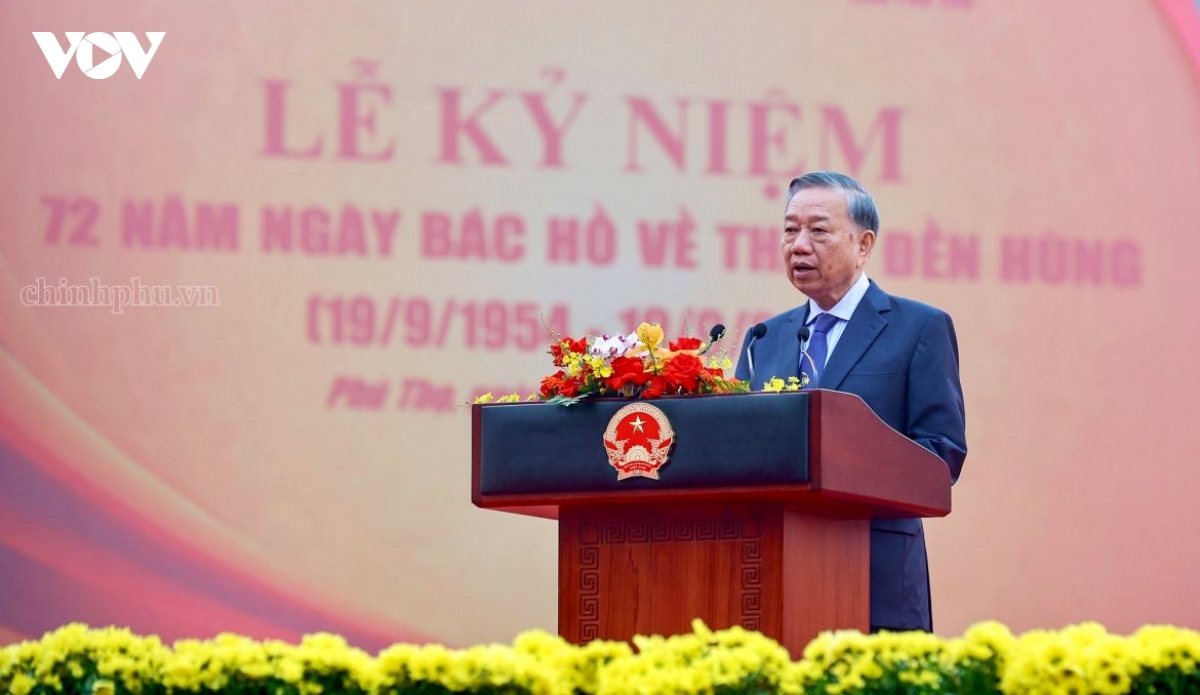
The top leader made the remarks at a ceremony marking the 72nd anniversary of President Ho Chi Minh’s visit to Hung Kings Temple complex and inaugurating the “Uncle Ho with the Nation’s Festival” Monument. The ceremony was held at the Hung Kings Temple Special National Historical Site in Phu Tho province on September 19.
On September 19, 1954 President Ho Chi Minh met officers and soldiers of the Tien Phong Army Division at Gieng Temple, part of the Hung King Temple complex and said “The Hung Kings built the nation; we must work together to safeguard it.”
Recalling President Ho Chi Minh’s words, General Secretary and State President To Lam stressed that every generation of Vietnamese people has a responsibility to preserve the legacy of their forebears and contribute to the country’s continued development.
The independence secured through enormous sacrifices must therefore be firmly protected, he said, while the achievements of previous generations must be carried forward through the contributions of people today so that future generations can live in peace and have better opportunities to develop.
Safeguarding the country through national strength
In a world marked by profound changes, peace, development and national self-reliance are facing new challenges, he noted. In implementing the Resolution of the 14th National Party Congress, Vietnam needs to tap its internal strength, proactively seize opportunities, combine national construction with national defence, and bring together national strength and the strength of the times to build and develop the country.
In terms of national defence, he underlined the need to resolutely and persistently safeguard independence, sovereignty, national unity and territorial integrity; protect the Fatherland from an early stage and from afar; and build a strong all-people national defence and people’s security posture firmly rooted in the people’s support.
But such strength, according to the top leader, cannot be built through defence and security alone.
“The strength to safeguard the country must be built on economic strength, scientific and technological capacity, and the will of national unity,” he affirmed
From this perspective, strengthening national capacity is an essential part of the task of safeguarding the country. Vietnam needs to harness the intelligence, talent and creativity of its people, raise productivity, master technology, and build a competitive and resilient economy.
The top leader called for every policy to be implemented thoroughly and effectively, with resources unlocked and conditions created for people to contribute.
The goal of becoming a developing country with modern industry and upper-middle income by 2030, and a developed, high-income country by 2045, requires decisive action from today. Each step forward must go hand in hand with better living standards, environmental protection and preservation of cultural identity.
“Patriotism must become a capacity to make the country stronger and people’s lives better,” he stressed.
“Together” as the strength to build and safeguard the country
If safeguarding the country is a responsibility shared across generations, leader To Lam’s speech underlined “together” as the condition for turning that responsibility into a source of national strength.
Drawing on President Ho Chi Minh’s message in 1954, the speech highlighted the strength of great national unity and the need to nurture solidarity and a shared sense of destiny among all Vietnamese people.
Unity should begin with listening to the people, promoting their right to mastery, ensuring fairness and respecting the diversity of communities. Everyone should have opportunities to develop their abilities, have their contributions recognised and share in the fruits of development. People in remote and disadvantaged areas should receive practical support and attention.
When people see their future as closely linked to the future of the country, the speech noted, national unity will be further strengthened.
Recalling President Ho Chi Minh’s 1954 instruction to the soldiers to maintain strict discipline, protect people’s lives and property, and avoid causing inconvenience to the people, General Secretary and State President To Lam also set out requirements for the Party and State apparatus today.
The Party must continue to renew and rectify itself, maintain its integrity and stay closely connected with the people. The State apparatus must be clean, effective and efficient, while efforts to combat corruption, waste and negative practices must continue and leading officials must uphold their responsibility to set an example.
Under this approach, studying and following President Ho Chi Minh’s moral example should not stop at awareness but must be reflected in work and results in serving the people.
“The results of studying and following President Ho Chi Minh’s example must be reflected in better work and better service to the people,” he said.
This requirement is also linked to the Ho Chi Minh approach emphasised in the speech, which involves staying close to the grassroots, understanding reality accurately, identifying the right tasks, promoting democracy, listening to the people and accepting their supervision.
Preserving culture, passing responsibility to future generations
From the task of building and safeguarding the country today, the top leader also placed culture and people at the heart of national development.
According to him, culture nurtures patriotism and national resilience, providing a foundation for sustainable development. The “Uncle Ho with the Nation’s Festival” Monument should therefore not only serve as a commemorative work but also be developed as a place for historical education and for fostering civic responsibility and affection for the country.
He asked Phu Tho province to work with relevant agencies to manage and protect the monument over the long term, preserve the solemnity, landscape and values of the historical site, and organise meaningful visits to historical sites and educational activities with accurate, accessible content suited to different age groups.
Alongside heritage preservation, he highlighted the use of technology to enable people living far away and international friends to access and learn about Vietnam’s history and culture.
For younger generations, the message focused on their responsibility to carry forward the journey begun by previous generations. He called on young people to study and train themselves to acquire knowledge, resilience and good health; live honestly and compassionately; care for others; master science and technology; and confidently engage with the wider world.
The Party, State and society should also create favourable conditions for young people to develop their talents and contribute to the country, he affirmed.

Declaration of Independence puts people at the heart of national strength
VOV.VN - Vietnam’s Declaration of Independence, proclaimed by President Ho Chi Minh on September 2, 1945, not only affirmed national independence but also placed people at the center of the country’s historical development and national strength.