What could drive 10% economic growth for Vietnam in 2026?

VOV.VN - Vietnam’s GDP grew 8.18% in the first half of 2026, but achieving 10% annual growth would require an 11.7% expansion in the second half, with industry, public investment, exports, domestic consumption and the private sector all needing to accelerate.
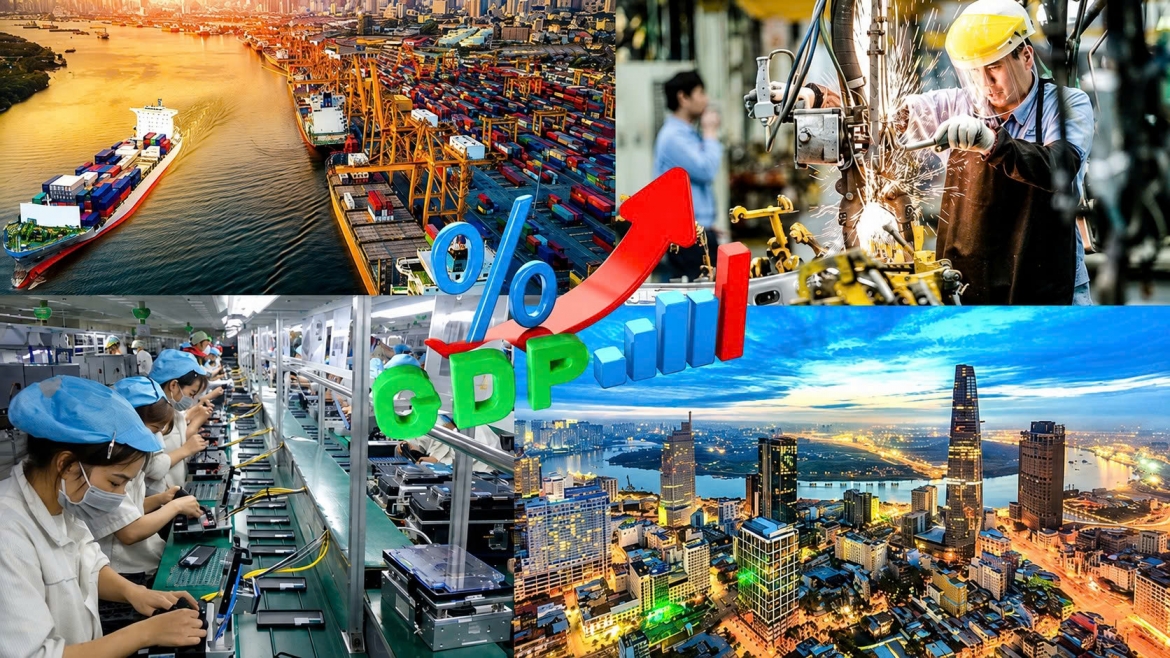
The 8.18% growth recorded in the first half shows that the economy has maintained a relatively positive foundation. GDP growth accelerated to 8.39% in the second quarter from the first quarter, while industrial production, consumption, investment and exports all posted significant gains.
According to the National Statistics Office, the Index of Industrial Production (IIP) rose 10.8% in the first six months, with manufacturing and processing increasing 11.4%. Total retail sales of goods and consumer service revenue grew 12.9%, while total realised social investment increased 12.9%. Total merchandise trade reached around US$549.69 billion, up 27.1%, with exports rising 21%.
However, these results do not mean that the 10% growth target for 2026 is within easy reach. The National Statistics Office calculated that, if annual GDP growth reaches 10%, GDP growth would need to reach around 11.7% in the second half that requires about 11.16% growth in the third quarter, and 12.09% in the fourth quarter.
This means the economy cannot simply maintain its current pace in the remaining months of the year. It must generate additional output at a significantly faster rate than in the first half. The key question is: Where will the additional growth come from, and which drivers can deliver a sufficiently rapid impact?
From 8.18% to 11.7%: A significant growth gap
Achieving 10% annual growth would require a substantial acceleration in the final two quarters. This will be challenging as Vietnam continues to face global economic uncertainties, trade barriers and growing competitive pressure on exports.
The gap between 8.18% growth in the first half and the required 11.7% in the second half also shows that the economy cannot rely on a single growth driver.
If public investment disbursement accelerates but production does not expand, its impact on GDP will be limited. If industrial output rises sharply while domestic demand and export orders weaken, producers could face difficulties in selling their output. Likewise, faster credit growth will have limited impact on economic growth if credit does not flow into productive activities capable of generating added value.
The 10% growth target therefore requires multiple drivers to be activated simultaneously, including those capable of generating output quickly in the short term and those that can expand the economy’s growth capacity over the longer term.
Drivers that could accelerate growth in the second half
Among existing growth drivers, manufacturing and processing are particularly important. In the first half, the sector’s IIP increased 11.4%. In GDP terms, manufacturing and processing grew 10.23% and contributed 2.73% to overall growth, the largest contribution among economic sectors.
This suggests that if production can maintain orders, expand capacity and bring new projects into operation, manufacturing and processing could be one of the key drivers of growth in the second half.
However, higher output must be matched by demand. In the first six months, the consumption index for manufacturing and processing rose 10.8%, while inventories at the end of June were 13.3% higher than a year earlier. This indicates that businesses need to maintain production while strengthening markets and orders to prevent higher capacity from putting further pressure on inventories.
Public investment is another driver capable of producing relatively rapid effects. According to the Ministry of Finance, public investment disbursement reached around VND356.935 trillion by the end of June, equivalent to 35.5% of the plan assigned by the Prime Minister.
A large amount of the remaining capital must therefore be disbursed in the final months of the year. Faster disbursement would not only directly support construction activity but also generate demand for steel, cement, machinery, transportation, logistics and related services.
However, the issue is not simply getting funds out of the budget. More importantly, public investment must be converted into completed infrastructure, construction output, jobs and actual added value.
Bottlenecks involving procedures, site clearance, implementation capacity and the ability to absorb capital therefore need to be addressed quickly. When an infrastructure project is implemented on schedule, its impact can spread across businesses and industries, creating broader economic effects.
Exports will also be an important growth driver. In the first half, merchandise exports increased 21%, supporting industrial production and logistics activity. This performance, the National Statistics Office reported, puts annual export growth on track to reach or exceed the 15-16% target set in Resolution No. 01.
However, exports depend heavily on external markets. To sustain growth, businesses must not only maintain orders but also adapt to increasingly stringent requirements on quality, traceability, environmental standards and greener production.
Domestic demand is another important piece of the puzzle. Total retail sales of goods and consumer service revenue increased 12.9% in the first half, or 7.3% after excluding price factors. International arrivals hit around 12.25 million, up 14.9%, continuing to support services, transportation, accommodation and tourism.
For consumption to become a stronger pillar, however, purchasing power needs to be supported by incomes, employment and consumer confidence. Rising incomes can boost consumption and generate additional orders for businesses, while stronger production and services can create more jobs and income. This virtuous cycle between supply and demand could become an important source of growth.
Unlocking the private sector and activating new drivers
While the drivers above can generate additional output in the short term, the strength of the private sector will have a major bearing on the economy’s ability to expand its growth base.
Achieving double-digit growth will be difficult if the economy relies primarily on public spending and the foreign direct investment (FDI) sector. Domestic businesses need to be able to expand production, invest in technology, hire workers and participate more deeply in supply chains.
This requires faster removal of bottlenecks involving capital, land, administrative procedures, market access and compliance costs. Credit should also be directed more strongly toward productive business activities capable of generating added value and expanding production capacity.
When businesses can access resources at reasonable costs, the impact on GDP goes beyond additional output. A company expanding a factory can create jobs, increase demand for raw materials, transportation, logistics and services, and generate additional income that supports consumption.
According to Dr. Can Van Luc, chief economist at the Bank for Investment and Development of Vietnam (BIDV), Vietnam has a basis for achieving strong growth in 2026 if it makes effective use of traditional drivers alongside activating new ones. Science and technology, digital transformation, green transition, institutional reform, regional connectivity and the resolution of long-standing projects could all make additional contributions if implemented effectively.
However, these new drivers need to be considered within an appropriate timeframe. In the second half of this year, science and technology or digital transformation are unlikely to immediately generate enough GDP to close the entire gap between 8.18% growth and the 10% target. Their greater value lies in raising productivity, reducing costs, opening up new business opportunities and laying the foundation for growth in the years ahead.
The 10% growth challenge is therefore not a choice between public investment, industry, exports, consumption and the private sector. These drivers are interconnected and can reinforce one another if activated simultaneously.
A public investment project implemented on schedule can generate orders for businesses. Business expansion creates jobs and income. Higher incomes support consumption, while greater production capacity can strengthen exports. When these links operate together, their impact on growth can be much greater than that of any single driver.
The second half of the year will therefore test the economy’s ability to turn resources into actual output. With 8.18% growth in the first half, achieving 10% for the full year will require not only a faster pace of expansion but also better policy coordination, faster removal of bottlenecks and more effective use of available resources.
If public investment is absorbed effectively, industry and exports maintain their momentum, domestic demand continues to improve and the private sector gains better access to resources, the economy will have a stronger basis for moving toward double-digit growth.
Conversely, if resources remain tied up in administrative procedures, capital fails to translate into output or domestic demand weakens, the pressure for growth will fall on a smaller number of remaining drivers. The gap between 8.18% growth in the first half and the 10% annual target would then become an even greater challenge in the final months of the year.
How to clear key bottlenecks for 30% digital economy GDP target
VOV.VN - Vietnam’s digital economy is growing rapidly, but lifting its share from 14% of GDP to around 30% by 2030 requires more than just applying technology in business.