Vietnam posts fastest GDP growth in 15 years, double-digit goal still elusive

VOV.VN - Vietnam’s economy grew 8.18% in the first half of 2026, its strongest first-half performance since 2011, but economists caution sustaining this momentum and achieving the ambitious double-digit growth target for the full year will require stronger growth drivers alongside preserving macroeconomic stability.
Growth momentum on track
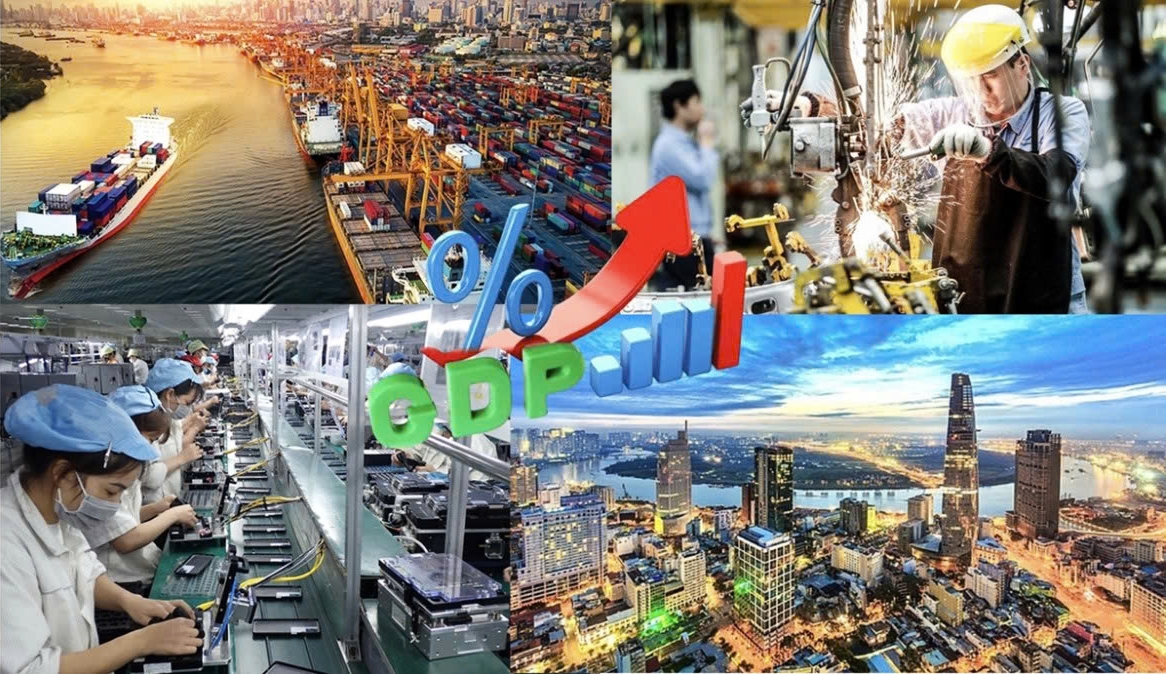
According to Minister of Finance Ngo Van Tuan, Vietnam has maintained growth momentum across most sectors, supported by both traditional economic drivers and emerging sources of growth. Several international organisations have also issued optimistic forecasts for the country’s economic outlook and inflation.
Statistics show Vietnam’s gross domestic product (GDP) grew by an estimated 8.39% year on year in the second quarter, bringing first-half growth to 8.18%, the highest level recorded since 2011.
Industry, construction and services accounted for more than 88% of overall growth, while manufacturing and processing continued to expand at a double-digit pace, reinforcing its role as the economy’s main growth engine.
Industrial production was also robust, with value added in the industrial sector increasing 9.86%, contributing more than 40% to overall GDP growth. Manufacturing alone expanded 10.23%, becoming the largest contributor to economic expansion.
Domestic consumption also continued to recover. Retail sales of goods and consumer service revenue reached nearly VND3.89 quadrillion, up 12.9% from a year earlier, reflecting improving consumer demand.
External trade also posted strong growth. Total import-export turnover was estimated at US$549.6 billion, up 27.1% year on year. Exports rose 21% to US$266.5 billion, the fastest pace since 2022, while imports climbed 33.4% to US$283.1 billion, driven by higher demand for production materials as well as rising global prices for crude oil and electronic components.
Foreign direct investment (FDI) was another bright spot. Newly registered FDI exceeded US$34.6 billion, up 61%, while disbursed capital reached nearly US$13.03 billion, an increase of 11.2% and the highest level in five years.
Business confidence also improved. Nearly 169,800 enterprises entered the market during the first six months of the year, an increase of 11% compared with the same period last year and exceeding the number of businesses exiting the market.
Major macroeconomic indicators were broadly stable. Average inflation stood at 4.38%, staying within the government's target range. State budget revenue reached nearly VND1.57 quadrillion, up 17%, while public investment disbursement totalled almost VND357 trillion, equivalent to 35.5% of the annual plan.
Double-digit growth remains a challenge
Despite the positive economic performance, officials acknowledge that achieving double-digit GDP growth this year will not be easy.
Minister Tuan noted that although first-half growth reached its highest level in many years, it was about 1.5% below the government's growth scenario. Meanwhile, inflation has moved closer to the annual target, leaving policymakers with less room for further stimulus.
According to Nguyen Thi Huong, director of the National Statistics Office, maintaining macroeconomic stability is the biggest challenge. She warned that rising imports of production materials or higher global commodity prices could shift Vietnam’s trade balance from surplus to deficit, putting pressure on the exchange rate, foreign exchange reserves, the balance of payments and imported inflation.
Domestically, consumer demand has yet to recover fully. Changes in consumer behaviour continue to weigh on spending, slowing cash flow across the retail and service sectors and creating additional pressure for businesses.
At the same time, domestic firms face increasing competition from imported products while differences in production capacity continue to widen, raising the risk of losing market share even within Vietnam.
Economic management has therefore become more complex, requiring policymakers to strike a balance between supporting growth through lower interest rates, stronger domestic demand and business assistance while maintaining inflation control, exchange-rate stability and broader macroeconomic balance.
External risks were also significant. Demand in Vietnam’s major export markets has yet to recover fully, global trade protectionism continues to rise, major central banks are maintaining relatively high interest rates, while logistics costs and energy prices remain volatile.
Sustainable foundations are essential
Speaking to VOV.VN, Nguyen Quang Huy, chief executive officer of the Faculty of Finance and Banking at Nguyen Trai University, agreed the government's double-digit growth target serves as an important strategic objective that encourages reform and strengthens development ambitions. However, he stressed that faster growth should not come at the expense of long-term macroeconomic stability.
In the short term, he said Vietnam should continue removing obstacles facing businesses, strengthen coordination between fiscal and monetary policies, stimulate domestic consumption and better leverage the country's market of more than 100 million people.
Over the longer term, priorities should include improving resource allocation, enhancing the quality of public investment, attracting high-quality FDI into high-tech industries and developing a more transparent and efficient capital market.
More importantly, Huy noted, sustainable double-digit growth will ultimately depend on new growth drivers, including institutional reform, high-quality human resources, science and technology, innovation, digital transformation and the green economy.
Vietnam’s strong first-half GDP performance demonstrates the economy's resilience and recovery capacity. However, the gap between growth of just over 8% and the government's double-digit target remains considerable. The challenge for the second half of the year will therefore be not only to sustain current momentum, but also to generate stronger growth drivers, alongside preserving macroeconomic stability and long-term economic resilience.

Vietnam targets digital economy to contribute 30% of GDP by 2030
VOV.VN - Vietnam aims for the digital economy to contribute around 30% of GDP by 2030 under a newly approved national programme that places artificial intelligence (AI), data infrastructure and digital transformation at the centre of the country’s next growth model.