


Core technology opens new horizons for Vietnam-France cooperation

VOV.VN - General Secretary of the Communist Party of Vietnam Central Committee and President To Lam’s official visit to France is expected to add fresh impetus to bilateral ties, shifting cooperation significantly from trade to core technology, as Vietnam faces the imperative of qualitatively transforming its growth model by making science, technology, and innovation key drivers.
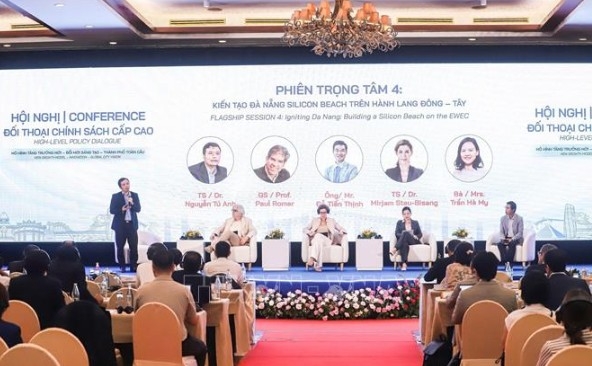
Speaking to the press in Paris, Tran Ha My, Chairwoman of the Vietnamese Young Businesspeople Association in Europe (VYBE) and Director in France of the Vietnam Innovation Network in Europe (VINEU), noted that the visit's greatest significance lies in its timing, coinciding with a critical juncture where Vietnam's growth model must undergo a qualitative transformation.
From a macroeconomic perspective, Vietnam stands at a structural inflection point in its growth model. Analyzing through the Solow-Swan growth model, where economic output is determined by technology, capital, and labor, capital accounted for an average of 86% of Gross Domestic Product (GDP) growth between 1995 and 2024.
This shows an economy heavily reliant on investment accumulation. Meanwhile, Total Factor Productivity (TFP), representing endogenous technological capacity and innovation, contributed only 6% to 7% over the same period, despite notable improvements in certain years reaching over 40%.
Tran Ha My, who also serves as a key partner of the Vietnam International Financial Centre (VIFC) and founder-chairwoman of Danang Fintech Lab (DFL24), pointed out that the target for the 2026-2030 period is highly specific.
To achieve double-digit GDP growth, the incremental capital-output ratio (ICOR) must be maintained at an efficient level of around 4.5. Simultaneously, as labor force contribution slows to approximately 0.7% annually due to an aging population, labor productivity must surge by 8.5% annually, and TFP's contribution share must increase from the current 47% to over 55%.
This target cannot be met by simply pumping in more capital or recruiting more labor, but demands a genuine breakthrough in core technology. This transition bears similarities to the take-off phases of the Republic of Korea (RoK), Taiwan (China), and Singapore during the 1980s and 1990s, when TFP contributed 40% to 50% to growth.
A core factor enabling these Asian economies to overcome the middle-income trap was maintaining high research and development (R&D) expenditure, with the RoK reaching 2.5% of GDP compared to 0.1%-0.6% in Southeast Asian nations during the same period.
Consequently, the visit to France carries far more substantive weight than a routine diplomatic engagement. France concentrates technological capabilities that can help Vietnam boost TFP, such as advanced materials and quantum technology at Paris-Saclay, aerospace in Toulouse, and nuclear energy at national research institutes. Scheduling the official visit seamlessly alongside attendance at the Aerospace Summit, within the framework of the Comprehensive Strategic Partnership established in October 2024, signals a clear shift in focus from merchandise trade to core technology transfer, aligning with the breakthrough spirit set by the Politburo's Resolution No. 57 on national science, technology, and digital transformation.
From an investment perspective, French investors and policymakers view Vietnam through at least five parallel legal frameworks, each unlocking different streams of capital and technology. This differentiation sets the current cooperation phase apart from the past.
As recently shared by Vietnamese Ambassador to France Trinh Duc Hai, in the second half of 2026, the Embassy will simultaneously prioritize multiple pillars: strategic infrastructure, high-speed rail, energy, defense industry, aerospace, international financial centers, artificial intelligence, and semiconductors. Prior to the visit, Minister of Science and Technology Vu Hai Quan also confirmed that space technology and nuclear energy are two newly anticipated areas of cooperation.
The first sector is high-speed transport infrastructure. Resolution No. 172 approved the investment policy for the North-South high-speed railway project, spanning approximately 1,541 km with a design speed of 350 km/h, scheduled to break ground before December 31, 2026.
France holds direct technological advantages in this field through its TGV and Alstom ecosystems. Unlike pure financial capital, French capital inflows into this sector will be bundled with the transfer of material technologies, such as specialized rail steel, signaling systems, and electrification. This technology-embedded capital is precisely what a multibillion-dollar infrastructure project requires far more than standalone financial funds.
The second sector is nuclear energy. Also at its 2024 session, the National Assembly decided to restart the Ninh Thuan nuclear power project after an 8-year suspension. France possesses world-leading capabilities in this domain through EDF and the Framatome supply chain. The legal framework governing this field, ranging from nuclear safety to standards for heat- and radiation-resistant materials, requires government-to-government cooperation rather than mere commercial contracts, rendering a high-level visit's role virtually irreplaceable by pure business channels.
The third sector is semiconductors and digital technology industries. Decree No. 182 provides up to 50% subsidies for initial capital investment in high-tech R&D projects meeting capital scale and disbursement schedule conditions, while the Law on Digital Technology Industry, effective January 1, 2026, establishes the first dedicated legal framework for the sector.
This framework is of keen interest to European deep-tech venture capital funds, which require a legal environment capable of mitigating risks for long-term R&D investments, unlike development finance institutions.
The fourth sector is space technology and the aerospace-defense industry, aligning directly with the capabilities of Airbus, Thales, and French space research institutes. Linking this official visit to participation in the Aerospace Summit accurately reflects this new cooperation focus.
The fifth sector is the international financial center and the controlled testing mechanism (sandbox) for financial technology (fintech) under Resolution No. 222, effective September 1, 2025. Proparco, the private sector development financing arm of the French Development Agency (AFD), serves as a concrete example of a French institution with a long-standing presence in Vietnam that is accelerating its footprint. Proparco has financed US$50 million for VPBank, US$30 million for MSB for renewable energy, US$10 million for EVNFinance supporting rooftop solar, and invested US$15 million in Mekong Enterprise Fund IV. In March 2026, Proparco signed a memorandum of understanding with Nam A Bank to develop a green financial community.
This trajectory demonstrates a clear shift from traditional banking finance toward more complex green and digital financial structures, products that the new sandbox mechanism, backed by a 30-year preferential 10% corporate income tax rate for prioritized sectors, will facilitate for testing and scaling.
The common point across all five sectors is their inclusion in the 2026–2028 Action Plan of the Vietnam-France Comprehensive Strategic Partnership framework, shifting bilateral ties from framework signing to concrete project implementation. The substantive role of this visit lies not in opening a single isolated cooperation area, but in generating political catalysts to advance five parallel capital and technology streams consistently, rather than in the fragmented manner of past years.
The foundation of bilateral trade, which has expanded by roughly 42% over the past decade, demonstrates a solid basis for realizing these goals. However, the speed of translating political commitments into actual capital inflows still depends on how swiftly and synchronously guiding decrees for each sector are issued over the next 12 to 18 months.
Apart from capital and technology, a systematic approach is required to engage Vietnamese experts and intellectuals in France more deeply in national development. International experience shows that countries successful in attracting diaspora brainpower typically rely on structural models. South Korea, through the Korea Institute of Science and Technology (KIST) established in 1966, utilized top-level political commitment to break administrative inertia. China, via the Thousand Talents Plan since 2008, deployed large-scale financial leverage. Taiwan (China) built a synchronized residential and research ecosystem at the Hsinchu Science Park starting in 1980, laying the groundwork for TSMC's rise.
For the community of over 400,000 Vietnamese in France, including more than 60,000 intellectuals and some 6,000 to 7,000 students annually, Vietnam needs a tailored model suited to this community's characteristics. Vietnamese intellectuals in France lean heavily toward academic and scholarly research, with many trained at elite French schools and concentrated in specialized clusters, such as aerospace in Toulouse with Airbus, and energy and artificial intelligence at Paris-Saclay. Therefore, attraction mechanisms cannot rely purely on Silicon Valley-style commercial startup culture, but must target long-term research-training cooperation under strong political patronage, similar to the Vietnam-Institute of Science and Technology (VKIST) model.
A concrete model moving in this direction occurred during a meeting with overseas Vietnamese intellectuals in France in June 2025, when the Prime Minister directly requested Professor Nguyen Van Tam of the Institut Polytechnique de Paris (IP Paris) to formulate a training program for 100 artificial intelligence engineers for Vietnam, a pilot model worthy of replication. Drawing from this reality, Tran Ha My proposed three solutions closely aligned with Politburo Resolution No. 23 on overseas Vietnamese affairs:
First, institutionalize targeted training and transfer programs with specific timeframes, moving beyond general experience-sharing forums.
Second, associations such as the Vietnamese Young Businesspeople Association in Europe (VYBE) and the Vietnam Innovation Network in Europe (VINEU) should be directly integrated into agenda-building when state-level delegations work in Europe.
Third, considered decisive for transforming knowledge into commercial products rather than stopping at training, is pairing these initiatives with a dedicated co-financing mechanism, such as establishing small-scale co-investment funds between the diaspora and domestic technology innovation funds. The Politburo's latest policy framework on leveraging overseas Vietnamese resources provides the institutional foundation to actualize these directions in the coming period.
Vietnam–France ties poised for deeper, more practical cooperation
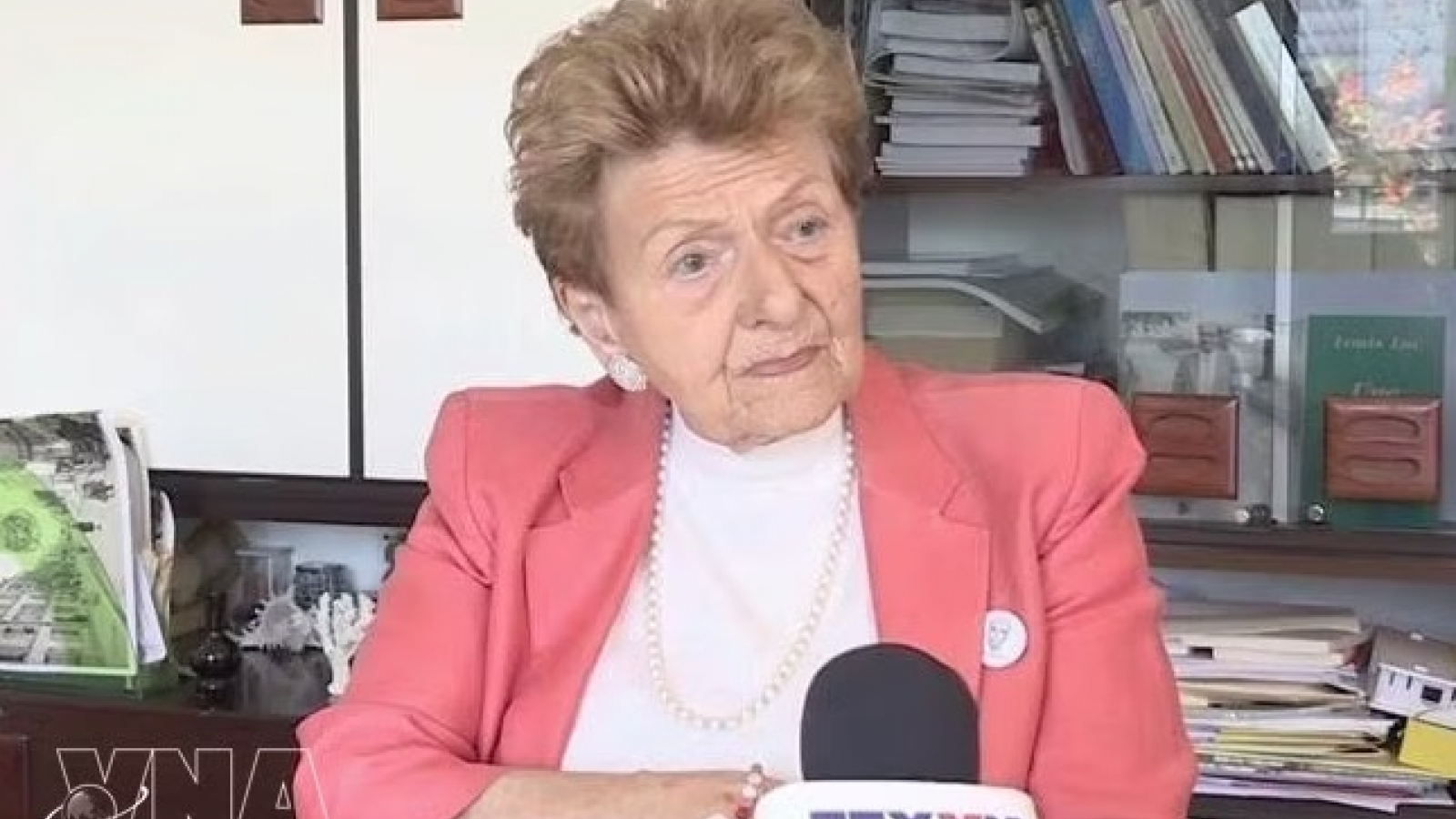
Helene Luc, French Honorary Senator and Honorary President of the France–Vietnam Friendship Association (AAFV), hopes General Secretary of the Communist Party of Vietnam Central Committee and President To Lam’s upcoming visit to France will give fresh momentum to the two countries’ Comprehensive Strategic Partnership.
Top leader’s visit to concretise strategic vision for Vietnam-France relations
General Secretary of the Communist Party of Vietnam Central Committee and President To Lam’s upcoming official visit to France and attendance at the International Space Summit in Paris will provide fresh impetus to bilateral ties and help concretise the strategic vision for Vietnam-France relations.